Monday, September 26, 2011

Blog #4: Shepard's Pie and Buttermilk Biscuits

Shepard's pie, originally known as cottage pie, originated in Western Europe as a hearty meal that could be afforded by common folk as it was composed of mashed potatoes, vegetables and cooked meat scraps. recipe Ground beef was used in this recipe, likely because it has alot of surface area and was easy to cook with the vegetables. We basically cooked a skilletfull of vegetables and ground beef, then poured that into a mashed potato shell.
  I do not eat beef, so I did not sample our final product, which looked a little bit like this picture from this website.
As a vegetarian friendly accent to our dish we made a buttermilk biscuits recipe. Like most pastries and breads this recipe includes a leavening agent, which is used to created gas bubbles and soften the final product. Butter has to be "cut-in" to the dough in order to produce the flakey texture one associates with biscuits or perhaps scones. I personally think this is the most crititcal part of the final product.

this picture came from here

Sunday, September 11, 2011

Three countries that make up the British Isle are Ireland, Scotland and Mediocre Britain. The climate in this area is relatively cloudy and rainy. The Isles have been traditionally sustained by grains such as oats, which grow well under these conditions. The isles themselves formed when the tectonic plate craton Baltica buckled into terrane Avalonia. wiki
We made simple scones:
Simple Scones Recipe
Allrecipes
>2 cups all-purpose flour
  • 1/3 cup sugar

  • 1 teaspoon baking powder

  • 1/4 teaspoon baking soda

  • 1/2 teaspoon salt

  • 8 tablespoons unsalted butter, frozen

  • 1/2 chocolate chips

  • 1/2 cup sour cream

  • 1 large egg Allrecipes


  • Scones originated in Scotland as heftly disk of flattened oats which were cut into slices. Once the recipe included baking powder, people began to see potential and the scone diffused to Europe and the world. Our scones were absolutely great I was impressed.  wiki
    , and we made Bread Pudding
    6 slices day-old bread
  • 2 tablespoons butter, melted

  • 1/2 cup raisins (optional)

  • 4 eggs, beaten

  • 2 cups milk

  • 3/4 cup white sugar

  • 1 teaspoon ground cinnamon

  • 1 teaspoon vanilla extract Allrecipes


  • Bread pudding is has actually been made in different forms all over the world, but among the most famous is that from England and France. It is popular because it transforms stale bread into a tasty baked goopball.

    Blog Number 2: South America


    Recipe:
  • 3 cups flour (plus a little more for kneading)

  • 1 teaspoon salt

  • 1/2 cup cold water

  • 1 egg

  • 1 egg white

  • 1 teaspoon vinegar

  • 3 tablespoons shortening

  •  www.latinfood.about.com

    Empenadas are in fact not South American in origin, although they are closely associated with South American cousine. In fact, they are European, specifically spanish. They were particularly easy to make, and although we undercooked them, they were delicious. We used a sweet recipe utilizing nutella and strawberry jam instead of a savory alternative. After doing some research later I learned a valuable secret of using egg whites to seal the pastry shut, which probably would have helped the professionalism of our plate. http://www.wikipedia.org/
    ----------------------------------------------------------------------------------------------------------------------------
    Salsa: A spicy sauce of chopped, usually uncooked vegetables or fruit, especially
    tomatoes, onions, and chili peppers, used as a condiment. http://www.dictionary.com/

    Other great salsas include pico de gallo, salsa verde and mexican corn salsa. Jalapenos are traditionally grown in mexico but they are now grown all over the world. Wiki My entire kitchen group had to take test retakes this particular day, leaving me to make salsa on my lonesome. It wasnt terrible, but due to poor dicing technique, neglecting to remove tomato seeds and a slip of the wrist when applying salt it a unique flavor and texture.
    ----------------------------------------------------------------------------------------------------------------------------

    I failed to procure a recipe for the Brasiliera cookies, and google yielded no recipe or pictures. Additionally, despite participating in the preperation I failed to really grasp now the sugar drip technique worked. So much sugar ended up wasted in the bottom of the cup it seemed inefficient. What I can say is that the cookies turned out to be fantastic, the best cookies I have had in a long time. I am planning to get ahold of that recipe and have Ellie explain the sugar drip. They were compact and chewy, but had an amazingly subtle crispy crunchy texture.

    Thursday, August 25, 2011

    Blog Entry #1

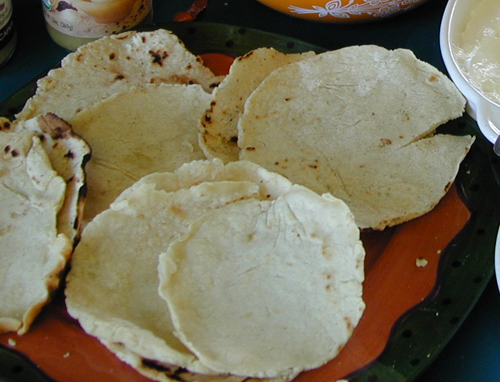
    1. Photo stolen from "Norwitz Notions"
    
    2. In order to cook our tortillas, we first pre-heated the skillet for about 20 minutes, or exactly how long it took to do everything else. Everything else entailed putting one and a half cups of flour in a ziplock bag, then adding a pinch of salt, a dash of baking powder and 4 splatters of Crisco. After about 14 seconds of debate, we decided to throw a few more handfuls of flour in the mix. I personally think that this was our tortillas downfall. After struggling to stretch the dry cracked dough thin, I through it on the skillet. Pretty soon I realized that the skillet its self was concaved (a less than idea design). This was when I switched to a cooking style more appropriate for scrambled eggs. At this point, morale was pretty low in my kitchen, but several minutes later I was happily munching down on a bag of half cooked shredded dough slivers.

    3. If the intention was to make real tortillas, I imagine we should have had a better understanding of what consistentcy the dough was. In addition to that, a flat skillet would have been very helpful, although from what I briefly read after stealing the above picture, it seems to me as though the flatness of the dough is critical. Apprarently their is a device called a "tortilla press" that greatly enhances the final product.

    4. Although the word tortilla is Spanish, the snack itself is mesoamerican. While tortilla in spanish often refers to a dish with ingredients wrapped in a cooked dough disk, the Aztec corn toritilla is a 10,000 year old traditon. Although this began as a time consuming process involving a mortar and pestle, the descendants of the aztecs now wield automatic tortilla machines on the streets of modern Mexico. http://en.wikipedia.org/wiki/Tortilla

    5. In Mayan and Aztec culture, Maize was the staple crop. Grown in gigantic quantities, the indigenous people used corn in almost every dish, and became very adept at manipulating the components of the crop.